
'In order to achieve Pakistan's psychological isolation and pariah status, breaking all cultural, economic and people to people contacts must become a government policy with clear linkage to a change in behaviour by the Pakistani regime.'
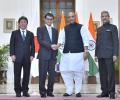
The India-Japan 2+2 dialogue added strategic heft to the special relationship in the wake of growing Chinese assertiveness on regional affairs, points out Dr Rajaram Panda.

The Pythagoras theorem 'should either be an Egyptian theorem if you look at the standard of just having an idea about it, an Indian theorem if you're looking for a complete statement of it, or a Chinese theorem if you're looking for the proof of it,' Fields Medal winner and Princeton University Professor Dr Manjul Bharava tells P Rajendran/Rediff.com

The decision to introduce vastu shastra as a part of the architecture curriculum at IIT-Kharagpur has polarised architects in the country. Nikita Puri reports.

Outlining eight "pillars" for the future of India-China relations, President Pranab Mukherjee on Wednesday underlined the need for comprehensively resolving challenges including the boundary question through "political acumen" and "civilisational wisdom".
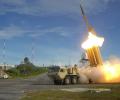
Deployment of THAAD in South Korea could unfold a new cataclysm in the Korean Peninsula with unwelcome prospects.

After Pyongyang tests a missile potentially capable of reaching the US, Dr Rajaram Panda explores the realistic -- and peaceful -- options before Donald Trump and the international community at large.

Aseem Chhabra introduces us to the best of Berlinale.

Magsaysay Award winner Sonam Wangchuk speaks to Claude Arpi about his journey, his fights, his hopes and how he became an inspiration for the Bollywood blockbuster.

The party is finding increasing acceptability in the 18-35 years age group with Rahul Gandhi adding a million followers in the past 2 months and Facebook and Twitter also seeing similar spikes.

'The Kashmiri identity and its unique blend of Sufi Islam, its culture and language can best survive in a plural and secular India.' 'Neither independence nor merger with Pakistan can achieve that objective.' 'Peace will return to Kashmir only when Kashmiris realise this, else they will be part of the 1,000- year war,' says Colonel Anil A Athale (retd).

As India strives to make its Act East Policy a comprehensive politico-diplomatic and economic success, Brunei gains more salience, says Dr Rahul Mishra.

After winning the Asian Games mixed doubles gold, Indian tennis' newest star sets sights on breaking into the top 100.

India and China have to narrow down differences and build on convergences by exploiting the potential of Panchsheel, the five principles of peaceful co-existence propounded by the two countries along with Myanmar in 1954, Vice President Hamid Ansari said on Saturday.

'Ensuring through diplomatic means and in conjunction with strategic partners that India will not be required to fight a simultaneous two-front war with China and Pakistan.' Brigadier Gurmeet Kanwal (retd) lists what India must have in its national security strategy.

'India does not wish to remain silent in improving its strategic space so that its leverage to counter China's expansionist designs is maintained, besides enabling it to play a responsible role from a position of strength for peace and stability in Asia,' points out Dr Rajaram Panda.

How did Greece, the country of Archimedes and Socrates and Plato and Pythagoras, come to such dire straits, asks Ajit Balakrishnan.

If the aim is to become a player with some strategic space of its own, not just in the Indian Ocean region but also in the adjoining region, then greater interaction with China is desirable, even necessary.
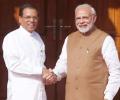
'Modi's first foreign trip at the very outset of his second term as PM reinforces a growing impression that this regional tour underscores a shift in emphasis in India's foreign policy that was traditionally focused on the northern tier of countries to the Indian Ocean rim,' explains Ambassador M K Bhadrakumar.

Chinese President Xi Jinping has suggested five thrust areas to improve relations with India. It is likely all these issues, in addition to the points raised by Xi at Fortaleza, will be part of the joint declaration at the end of his visit to India, says Srikanth Kondapalli.

Rediff.com's Rajesh Karkera shares his impressions from the Kochi-Muziris Biennale, India's landmark artistic extravaganza.

Patrick Bhai and Stephen Bhai are old friends of Gujarat.

Despite vast differences in the way the media operates in the two countries, an India-China media forum will go a long way in improving understanding between the two countries, says Srikanth Kondapalli.
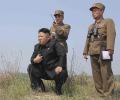
Pyongyang wants the world to recognise its nuclear capability, says Srikanth Kondapalli.

'We like to tell the rest of the world that we did it better, that we were stronger, that we had larger cities, that we taught them science,' Naman Ahuja tells Anjali Puri. 'This exhibition is an antidote to insularity -- it is saying we have learnt as much from the world as we have given it.'

'The Naga Hills region, Nagaland and Manipur, have had the most uncaring and corrupt state governments with little to show on the ground despite the nation's highest per capita development expenditure,' says Mohan Guruswamy.

'There is never a safe choice in the movie business.' 'Everything is chance.'

We can learn much from China with regards to making civil service recruitment more efficient, says former diplomat Kishan S Rana.

"Although we are kind of open Muslims, I don't want to show my body."
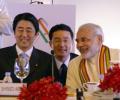
'Both nations have a common problem: A rampaging, jingoistic and hostile China which is making substantial territorial claims. In the long run, Japan and India are going to be the victims of Chinese aggression -- so they might as well hang together to contain China,' argues Rajeev Srinivasan.

'While economic ties are making incremental progress, it is in the security and strategic domains that the India-Japan synergy is more compelling,' says Dr Rajaram Panda.

With India's communication needs outstripping neighbours', companies are finding it easier for campaigns to be either based out of or outsourced to Indian agencies.

'The world may be desirous of peace, but not Kim Jong-un.' 'Should we then accept the old adage that to maintain peace, we should be prepared for war?' asks Rajaram Panda.

'This has been an ongoing process,' says Ambassador B S Prakash, India's former consul general in San Francisco, 'but I believe a Modi visit to the West Coast can be a force-multiplier.'
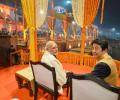
'Modi and Abe are working seriously for India-Japan bonhomie to grow stronger.' 'It is a win-win situation for both countries and the future look promising,' says Rajaram Panda, the Indian Council for Cultural Relations India Chair Visiting Professor at Reitaku University, Japan.

Nobel Peace prize winner Malala Yousafzai, Obama's daughters and Joshua Wong, the face of the Hong Kong protests against China have been named by Time magazine among its list of the 25 most influential teenagers of 2014.

While trying to persuade North Korea to give up its provocative actions, engaging China is the first hurdle that world leaders will have to deal with, says Rajaram Panda.

Rajaram Panda explains why the US president needs to restrain himself and build a relationship with China to put any credible pressure on North Korea.

An array of Olympians and stars of sports niche and new arrive in the South Korean city of Incheon for the 17th Asian Games this month, bringing together some 10,000 athletes for a 16-day multi-sport spectacular second only in scale to the Summer Olympics.
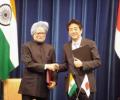
India's commitment to an open and plural security architecture attests to the fact that Asia's transition is a dynamic of both power & identity, says Zorawar Daulet Singh
 © 2026 Rediff.com - Advertise with us - Disclaimer - Privacy Policy - Sitemap - Feedback - About us - Terms of use - Grievances